


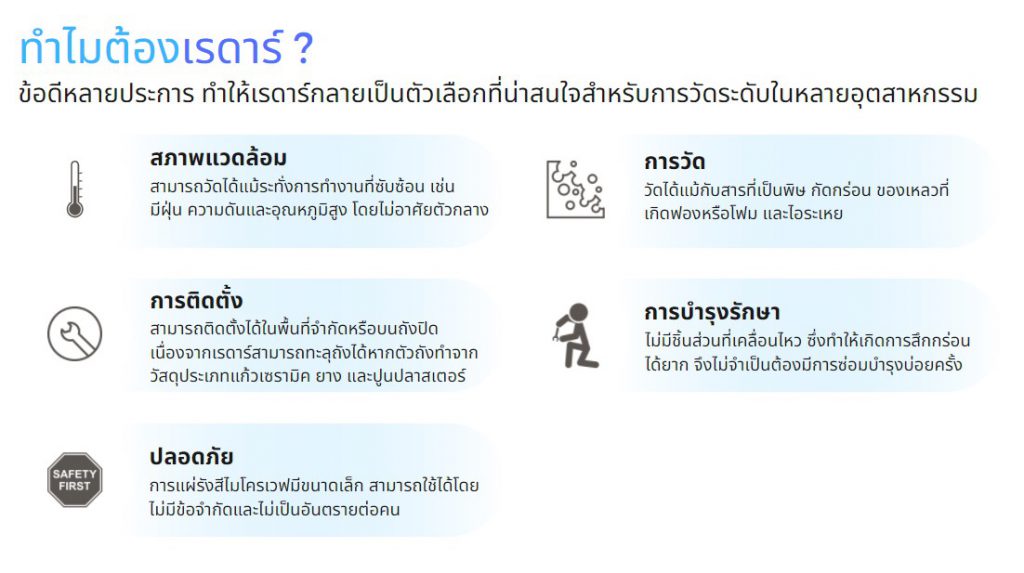
 Installation advantage is an important feature of radar sensors. In addition to being installed on a closed tank, it can be installed with limited space. Smart sensors are being developed for use in process noise and interferences such as blades, steam or dust on the probe. Radar level sensors have a wide range of angles for microwave radiation, depending on the manufacturer, such as ± 5 mm, ± 3 mm or up to ± 1 mm. The frequency of the wave affects the properties of level radar such as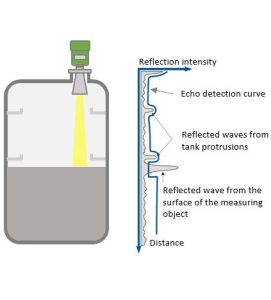
- Penetration of the radar signal – the wave length is longer at low frequencies and the attenuation is less and the wave can then penetrate more obstacles. But if the frequency is high, the wavelength will be shorter. This results in greater attenuation and less penetration. Therefore, low frequency sensors are suitable for many dust and vapor applications.
- Antenna – Planar antennas with low blind range are used at high frequencies but can be difficult to install in short pipelines. But if the frequency is low, the blind range will be longer. We must use the horn antenna.
- Beam angle – When the frequency is high, the angle is narrower, suitable for narrow space processing and avoiding obstacles. Even high frequencies are useful in applications but have limitations. Due to measuring on inclined or undulating surfaces, a wide beam angle produces wider reflections and better reflections are obtained.
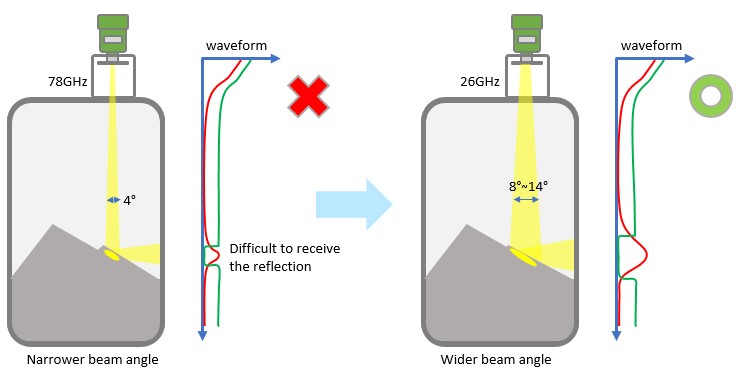
Due to measuring on inclined or undulating surfaces, a wide beam angle produces wider reflections and better reflections are obtained.
Matsushima – Radar level transmitter specifically designed for medium/long range measurement of all types of energies, particles and bulk solids. The compact and highly directional system with the use of higher frequencies can perform more stable level measurements. Adjustments can be made by entering simple parameters. An air filtration function is often integrated and there are many options such as angle adjustment for a wider range of installation environments. Radar level transmitter: MWLM-PR26Series (Solid Application) high efficiency, ability to penetrate vapor, dust, fog and haze. It is therefore ideal for dust and vapor conditions and can be used with large silos and small silos. Radar Level Transmitter Monitoring Water, Wastewater and River Works: MWLM-26Series It is specially designed for short/medium range measurement of liquids, sludge and sludge. Although it is possible to accurately measure solutions containing air bubbles or foam.
